
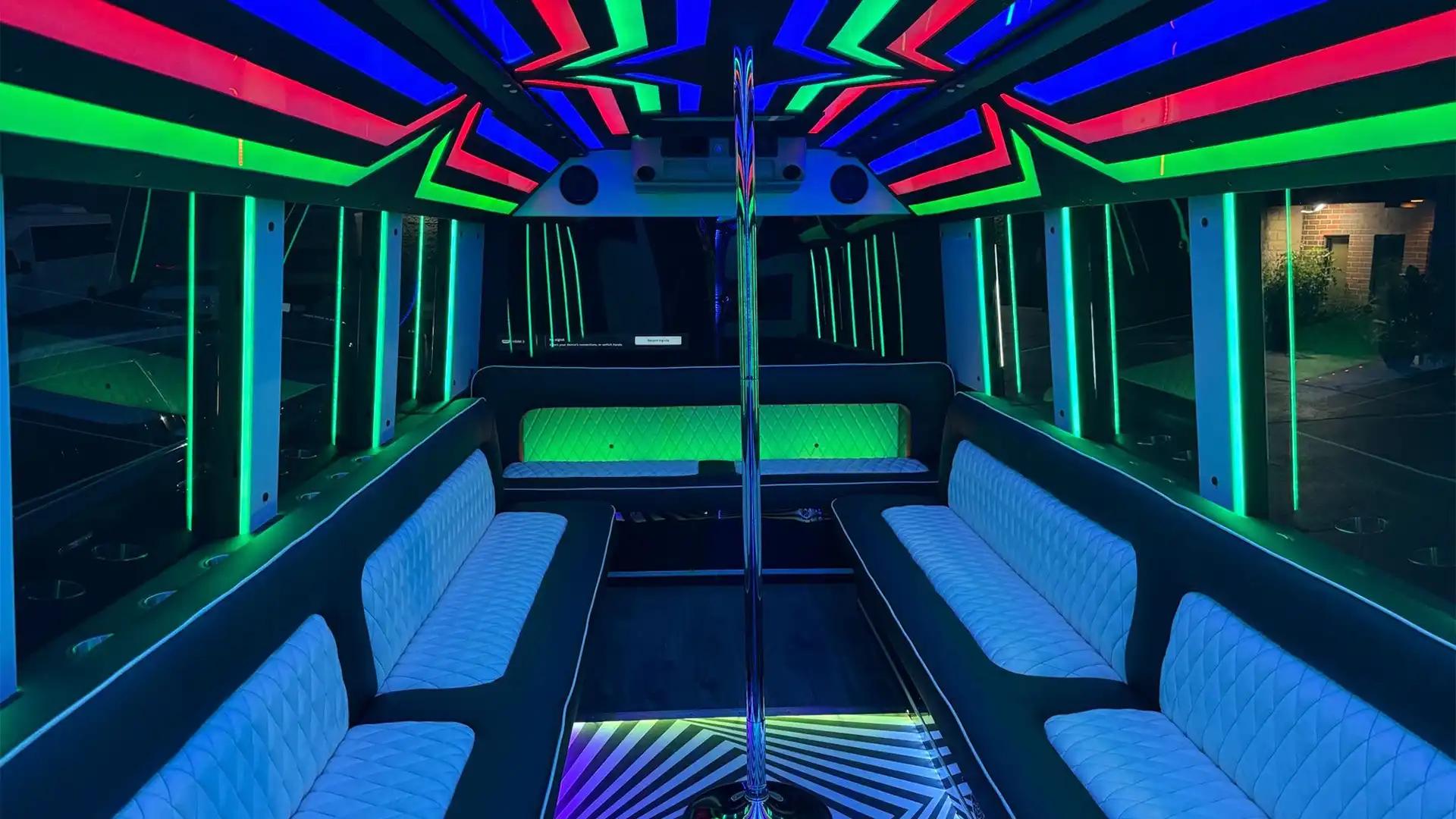

A 20-passenger party bus holds 20 people. That number is accurate, and it is also the reason a lot of groups have a worse night than they planned.
The rating counts how many people can be seated at once. It assumes everyone stays put, nobody has a coat, and nothing is on the floor. A party bus is bought for the opposite of that — people stand up, move around, dance, set drinks down and leave bags where they fall. The moment that happens, the usable number drops.
Here is what actually fits, why the two numbers differ, and how to size a vehicle for the night you're planning rather than the spec sheet.
Rated capacity vs real capacity
| Vehicle | Rated | Comfortable for a seated ride | Comfortable for an actual party |
|---|---|---|---|
| Sprinter limo bus | 12–14 | 12 | 8–10 |
| Small party bus | 18–20 | 18 | 13–15 |
| Mid-size party bus | 24–26 | 24 | 17–20 |
| Large party bus | 30–34 | 30 | 21–25 |
| Limo coach | 40+ | 40 | 28–32 |
The pattern across every size: plan on roughly 70–75% of the rated number if people will be up and moving. For a straight seated transfer — airport, venue to venue, nobody standing — the rated number is honest and you can use it.
That gap isn't a vehicle flaw. It's the difference between seating people and hosting them.
Why the numbers diverge
Party buses use perimeter bench seating — continuous upholstered benches along the walls, not individual seats. That's what makes the interior social, and it's also why capacity is elastic in a way a sedan's isn't.
A bench rated for five holds five people sitting shoulder to shoulder, squared up, not moving. Put four adults on it in winter coats and it's full. Put three in prom dresses on it and it's full. Nobody is being unreasonable — the linear inches simply ran out.
So the useful question isn't "how many seats does it have?" It's "how many linear feet of bench, and what are my guests wearing?"
What eats capacity
These are the things that reliably turn a comfortable booking into a cramped one:
| Factor | Effective cost |
|---|---|
| Winter coats | ~1 seat per 4–5 guests |
| Formalwear (gowns, prom dresses) | ~1 seat per 3–4 guests |
| Luggage or overnight bags | 1–2 seats per 3 bags |
| A cooler or drinks setup | 1–2 seats of floor space |
| Anyone planning to dance | 2–4 seats of standing room |
| Photo gear, gifts, decorations | Varies — ask before booking |
Chicago makes the first one nearly unavoidable for half the year. A November booking for 18 people in a 20-passenger bus is tight before anyone stands up, because eighteen coats have to live somewhere.
Sizing it for your group
Work from the night, not the headcount:
- Seated transfer, no drinks, no dancing — book the rated capacity. A 20-passenger bus genuinely moves 20 people to a venue.
- A party with a playlist — book rated capacity minus about 25%. For 20 guests, that means a 26-seat bus.
- Prom or a wedding party in formalwear — minus about 30%, and check the door and step height while you're at it.
- Winter, anything — add a size, or accept that a row becomes the coat rack.
- Mixed group with luggage — count bags as passengers. Three roller bags occupy about the space of two people.
The most common regret we hear is not "we booked too big." Going one size up costs less than most groups assume, and it is the difference between a bus people want to stay on and one they're glad to leave. If you're weighing sizes, our fleet lists what each configuration actually holds, and the party bus rental page covers what's included.
Count riders, not invitations
Almost every over-tight booking starts with the wrong number, not the wrong bus:
- Plus-ones are real people. If the invitation said "and guest," assume the guest is coming.
- Some of your group will drive themselves. Ask, don't assume — it cuts both ways.
- Parents and chaperones count. Prom bookings under-count this constantly.
- Photographers, coordinators, and anyone working the event take a seat too if they're riding.
Ask for a firm ride count rather than a guest count. They're rarely the same number, and only one of them determines the vehicle.
Where a party bus physically can't go in Chicago
Capacity isn't only about people. The bigger the vehicle, the more the city constrains it:
- Downtown parking garages — most have clearance under 7 feet. A party bus is not getting in. Plan a street pickup point instead.
- Narrow residential streets in Lincoln Park, Bucktown and Wicker Park make a 34-passenger bus a genuine problem, especially with parked cars on both sides.
- Venue driveways and porte-cochères — plenty of Chicago venues can't take anything longer than a sprinter at the door.
- Alley pickups are usually impossible for the larger sizes.
None of these rule out a big bus. They just mean the pickup point may be around the corner rather than at the door, and it's much better to know that when booking than to discover it on the night. If your group is large enough that these constraints start binding, large group transportation or a charter bus may fit the route better than one oversized party bus.
How much does a party bus cost in Chicago?
The honest answer is that party bus cost is driven by time, not by headcount — which catches people out, because they shop by passenger count.
A party bus is priced by the hour, and most nights out book a three-to-five-hour minimum. Your quote is flat and all-inclusive: the vehicle, a professional chauffeur, fuel and standard tolls, with no surge pricing and nothing added at the end of the night.
Four things move the number:
- The hours you book. By far the biggest lever. Going one size up costs less than adding two hours.
- Your date. A Saturday in June does not price like a Tuesday in February. If your date is flexible, ask about weekday and off-peak rates.
- The route. One venue is cheaper than a five-stop crawl across the city, because stops cost time.
- The size. Bigger buses cost more per hour — but see above: the wrong size costs you the night.
What it does not depend on is how many people you put inside. A 20-passenger bus costs the same with 12 aboard as with 20, which is exactly why splitting it across a full group is what makes it competitive for a night out.
Current starting rates for every vehicle class are published on our Chicago limo rates page, and a party bus rental in Chicago quote for your exact date takes seconds.
The short version
Take the rated number, subtract about a quarter if anyone will be standing, then check what your guests are wearing and carrying. That gets you to the right size on the first try.
If you'd rather just say "there are 22 of us, it's a birthday in February, and we're starting in River North," request a quote and we'll tell you what actually fits. We've been sizing these for Chicago groups since 2003, and it's a quicker conversation than the spec sheets suggest.
Frequently asked questions
How many people fit in a party bus?
It depends on whether they'll be seated. A 20-passenger party bus genuinely seats 20 people for a straight transfer, but for an actual party with people standing and moving, plan on 13 to 15. As a rule, expect about 70 to 75 percent of the rated capacity to be comfortable once guests are up and about.
How many people fit in a limo bus?
A sprinter-style limo bus is typically rated for 12 to 14 passengers and is comfortable for 8 to 10 if people are moving around. Larger limo coaches rated at 40 or more work well for around 28 to 32 in party use.
Is a party bus the same as a limo bus?
They overlap heavily and the terms are often used interchangeably. In practice a limo bus usually refers to a smaller sprinter-based vehicle with limo-style interior, while party bus tends to mean a larger vehicle built around perimeter bench seating, a sound system and standing room.
Should I round up or down when choosing a size?
Round up, particularly in winter or if anyone is in formalwear. Going one size larger costs far less than most groups expect, and the difference between a comfortable bus and a cramped one is usually a single size step.
Do coats and bags really affect capacity?
Yes, more than people expect. Winter coats consume roughly one seat's worth of space for every four or five guests, and three roller bags take about the room of two passengers. For a Chicago booking between November and March, factor coats in before you finalise the size.
Can a party bus pick us up anywhere in Chicago?
Almost anywhere, but not everywhere. Most downtown parking garages have clearance under seven feet, and narrow residential streets in areas like Lincoln Park and Wicker Park are difficult for the largest vehicles. Mention your pickup address when booking and we'll confirm the vehicle can reach it or suggest a nearby point.