
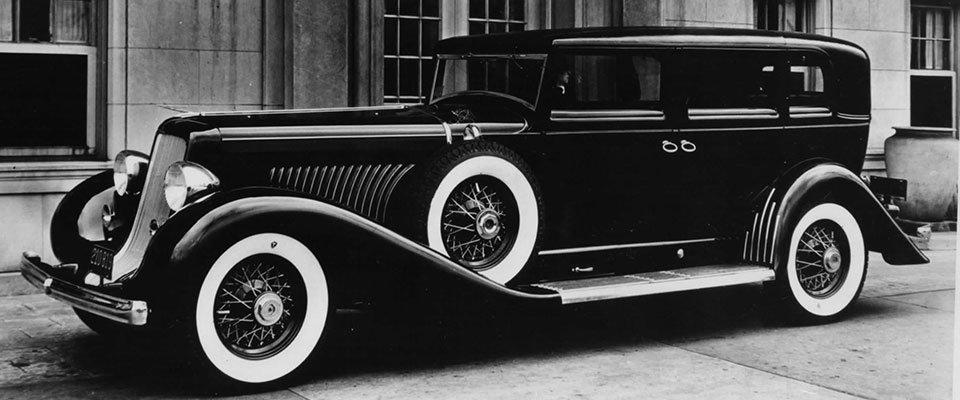

The limousine is older than the car. That sounds like a line, but it is the literal answer to where the vehicle came from: the idea of separating a driver from the people being driven arrived a century before anyone put an engine in front of it.
Here is the actual history, including the part most accounts get wrong.
Where the word comes from
The word comes from Limousin, a region in central France. That much is settled.
How a French region's name ended up on a car is not. The story you will read almost everywhere is that early chauffeurs, sitting outside in an open driving compartment, wore a hooded Limousin-style cloak for protection from the weather, and the car took its name from the garment. It is a good story and it may well be true — but it is a theory, not a documented fact, and reference works treat it as uncertain. A competing explanation points at the carriage style associated with the region rather than the cloak.
Anyone stating either version as settled fact is over-claiming.
The horse-drawn ancestor
Before the engine, wealthy French households used covered carriages in which the driver sat outside and forward, exposed, while passengers travelled enclosed behind him.
That arrangement was not about luxury for its own sake. It was about privacy and about who was working. The physical separation between the person driving and the people being driven is the defining feature of a limousine, and it was established in the 1700s. Everything since is an engineering variation on it.
The first motor limousines
Motorised limousines appear in the first years of the 1900s, barely two decades after the first practical automobile. Early examples such as the 1908 Studebaker and the 1915 Winton Six kept the arrangement exactly as the carriages had it — an enclosed rear compartment and an open driver's seat, with only a roof projecting forward over the driver.
By 1916 the term was formal enough for the US Society of Automobile Engineers to define it: a closed car seating three to five inside, with driver's seat outside. Two sub-categories existed alongside it — the berline, a limousine with the driver's seat fully enclosed, and the brougham, one with no roof over the driver at all.
So a 1916 limousine was not a long car. It was a car where the chauffeur got wet.
The stretch arrives, and it is not for celebrities
Stretch limousines began in the early 1920s, and their first purpose was working transport rather than glamour. Coachbuilders took a standard chassis, extended the wheelbase and added doors, producing multi-door vehicles for short intercity bus services — one of the earliest was built for a bus line, not a film star.
Touring musicians came next. Big bands needed to move a dozen people and their instruments between cities, and an extended car did it in one vehicle. The association with celebrity came later, and the association with proms and weddings later still.
The partition, and what it was for
The feature people picture — the glass partition between front and rear — has a practical origin. Once the driver's compartment was enclosed, the partition let passengers hold a private conversation, and it let the chauffeur do a job without being part of it.
Modern versions are usually retractable, operated by a button. The purpose has not changed: it is a privacy device, which is why it survives in executive sedans where nothing else about the 1916 definition does.
Where it stands now
The stretch limousine is no longer the centre of the industry it named. As of 2023 stretch limousines made up roughly one percent of what US limousine companies offered. Executive sedans, SUVs, Sprinter vans and party buses took over most of the work, because most journeys need a professional chauffeur and a fixed price rather than a long car.
What survives is the original idea, not the shape. A black car service sedan today has more in common with a 1908 limousine than a stretch does: a professional driver, a defined separation, a passenger who is there to be carried rather than to drive.
The novelty era left its own mark — Trabants, Beetles, Ferraris and Mini Coopers have all been stretched to carry up to ten people — but those were always the exception rather than the industry.
Why any of this matters when you book
Knowing the history changes what you ask for. "Limo" is a category defined by a chauffeur and a separation, not by length. If you want the traditional long car with facing bench seats, ask for a stretch specifically. If what you actually want is a professional driver and a fixed fare, a sedan or executive SUV is the direct descendant — see our fleet for what each configuration seats, and Chicago limo rates for current starting prices.
Frequently asked questions
Where does the word limousine come from?
From Limousin, a region in central France. How the region's name reached the car is not settled. The common story is that early chauffeurs wore a hooded Limousin-style cloak in the open driving compartment, but reference works treat that as a theory rather than a documented fact.
When was the limousine invented?
Motorised limousines appear in the first years of the 1900s, roughly two decades after the first practical automobile. The concept is older still: covered carriages with the driver seated outside and passengers enclosed behind were in use in France during the 1700s.
Who invented the limousine?
No single inventor is credited, because the limousine is a body style rather than a machine. It evolved from horse-drawn carriage design, and early motor examples were built by several manufacturers independently, including Studebaker in 1908 and Winton in 1915.
What was the first stretch limousine for?
Working transport, not glamour. Coachbuilders in the early 1920s extended standard chassis and added doors to create multi-door vehicles for short intercity bus services. Touring big bands adopted them next, to move a dozen musicians and their instruments in one vehicle.
Why do limousines have a partition?
It began as a practical consequence of enclosing the driver's compartment. The partition let passengers hold a private conversation and let the chauffeur work without being part of it. Modern versions are usually retractable and operated by a button, but the purpose is unchanged.
Are stretch limousines still common?
Much less than they once were. As of 2023 stretch limousines made up roughly one percent of what United States limousine companies offered. Executive sedans, SUVs, Sprinter vans and party buses now handle most of the work that stretches once did.